I want to begin with the idea this whole reflection is built around. Language is an architecture we think inside. Something built. Historical. Situated - and, for that reason, something that can be entered and rebuilt.
I did not come to this as a philosopher of language. I trained as an architect. That is why (maybe) for me “architecture” is not only a metaphor, in this context. What drew me to language was a personal observation: language quietly shapes what I am able to think in the first place. I wanted to know whether those decisions could be undone.
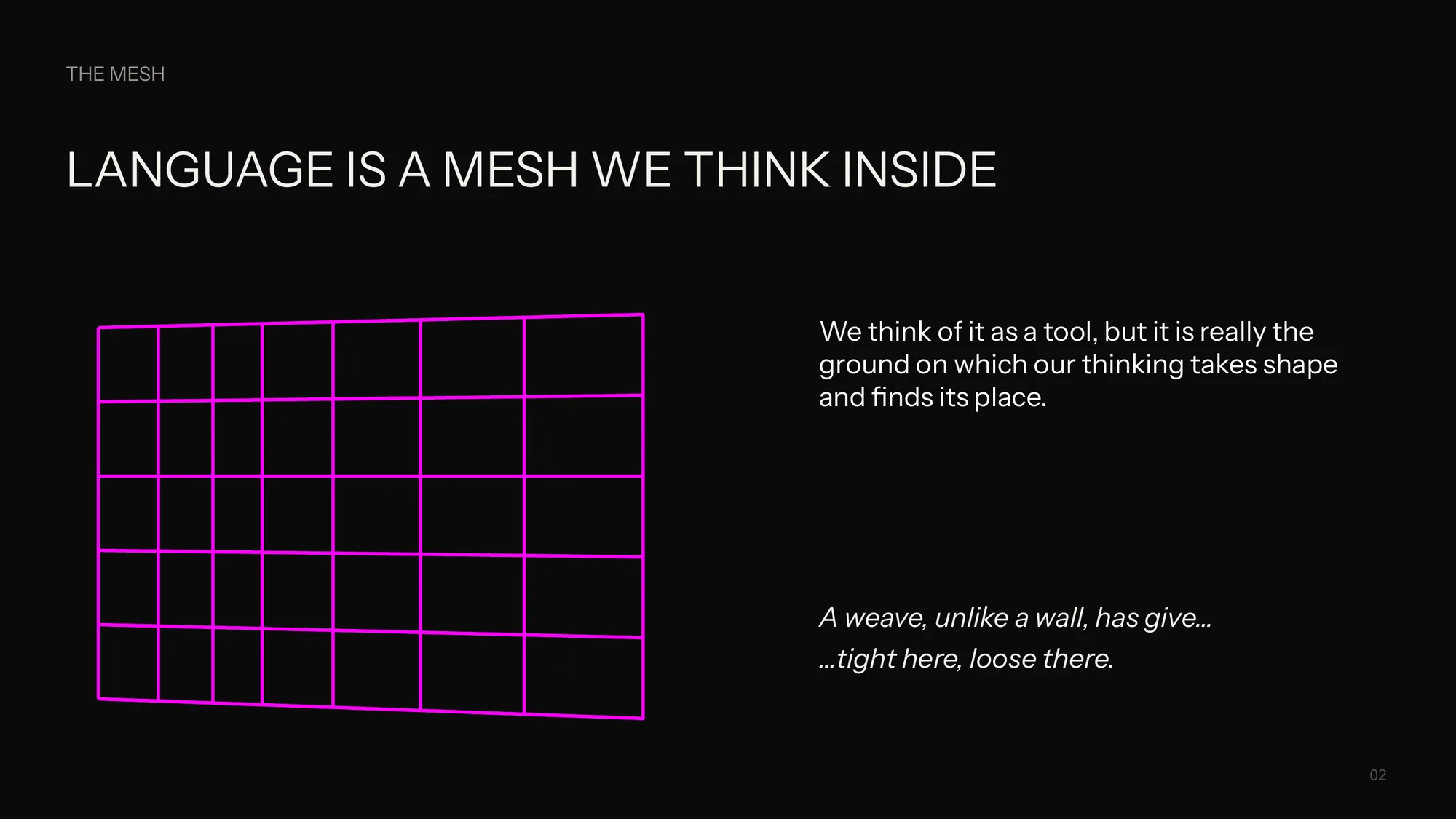
The image I keep returning to is a mesh. A weave. Picture a dense net of concepts, definitions and constraints. Each one holds the others in tension. Together they form the fabric through which we perceive what is, and imagine what could be. So when I say “language,” obviously I do not mean only the words we exchange. I mean the weave those words hang in. More than a neutral tool in our hands, I think of language as the ground beneath our thinking - something we think inside, rather than something we simply use.
And a weave, unlike a wall, has some give. You can feel where it is tight, and where it is loose. What holds the weave together is a set of constraints. The rules that decide how the threads cross.
It is tempting to treat these rules as natural. As if they lived in us, or in the nature of things. They do not. They settled over time. Through negotiation. Through history, and through power. This is the whole point - and the reason I’m here talking about change at all. If the constraints were natural, they would stand beyond question, almost like a law of some gods. Because they are historical, they can be questioned, and changed.
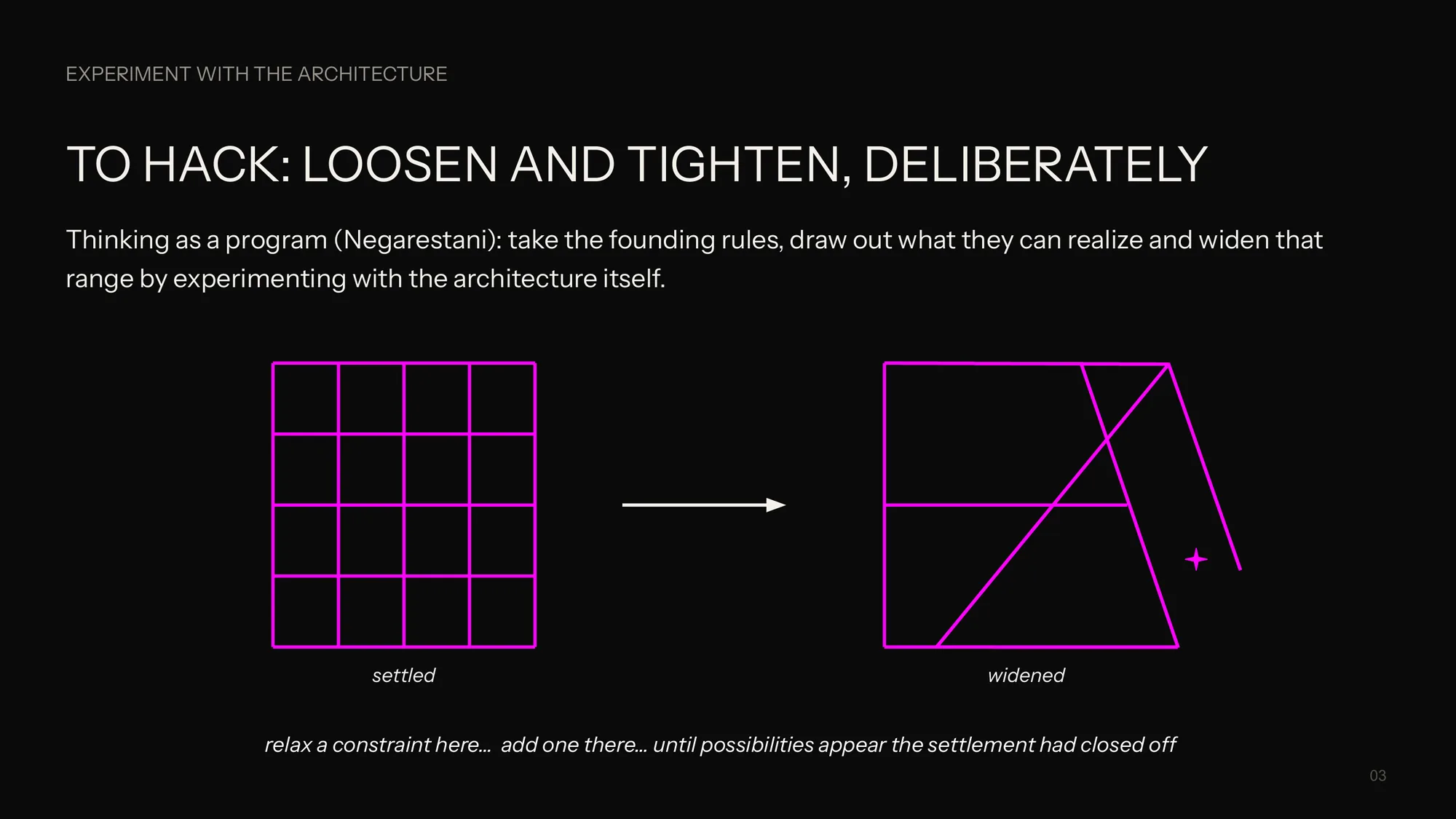
So the question becomes practical. If language is an architecture, how do you work on it? Here I lean on Reza Negarestani. He describes thinking itself as a kind of program - something that takes its founding rules and draws out what they can realize. And you explore a program, he says, by experimenting with its architecture. You loosen one constraint. You add another. And you widen what the system can become.
That, for me, is what it means to hack language. To loosen and tighten the weave on purpose - until the possibilities the old settlement had closed off come back into view.
This is the first part of this reflection. Before we can loosen anything, we have to look closely at the weave we live in. And today it is tangled with something new: the language of the machine.
Think about what a word becomes inside a computational system. It arrives as an input. Something to be classified, scored, routed and matched to a pattern. And its fate is decided by one question: can it be processed? The word that can run is treated as real. The word that cannot is set aside - as noise, as error, as anomaly. This looks like a small technical fact. It’s easy to miss. But in this regime, to exist as language is to be executable.
And everything that overflows the function - ambiguity, opacity, the many-layered word, the poetic turn - begins to look like static. Yet language, when it’s alive, is mostly overflow.
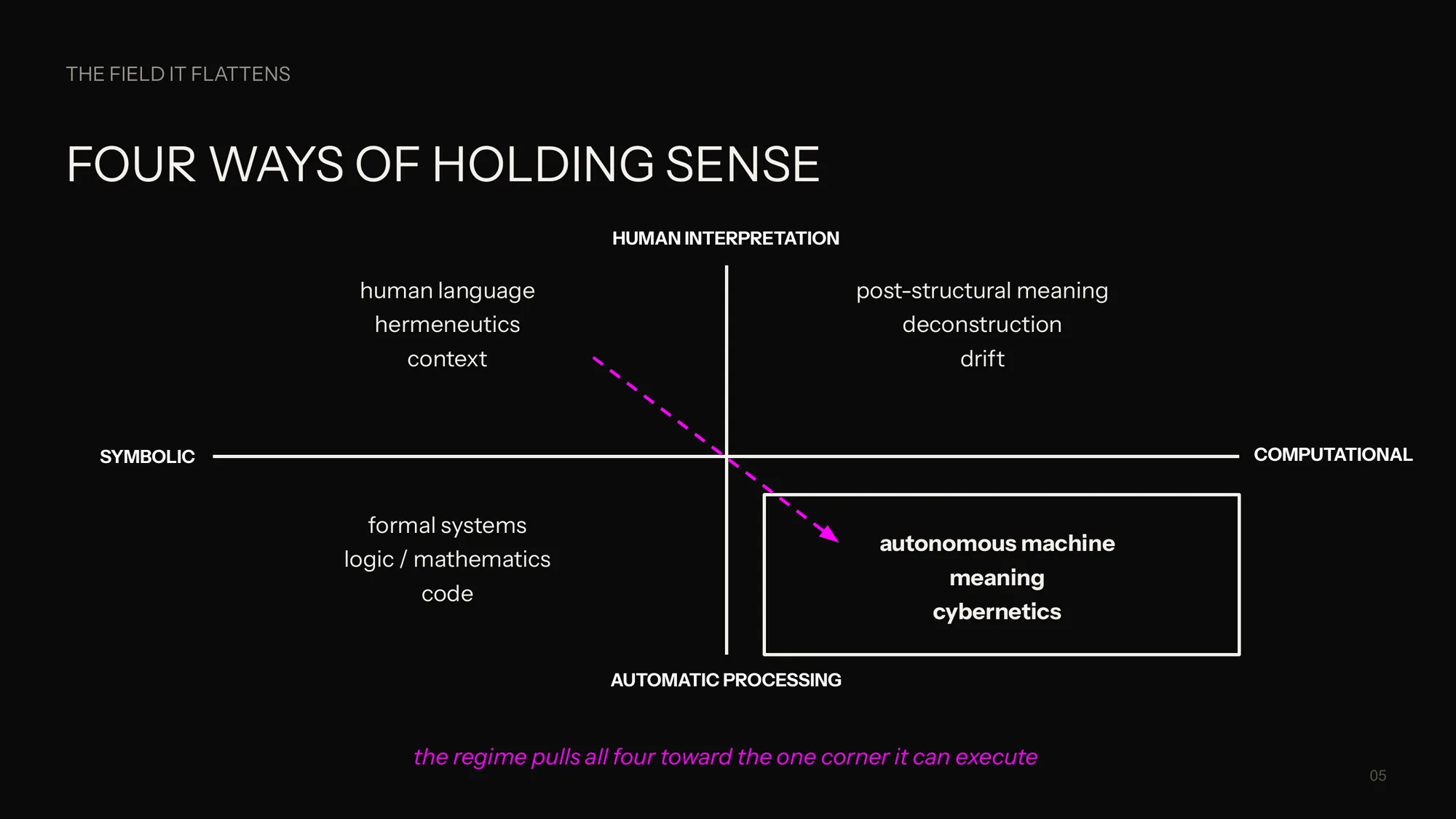
This flattening has a cost. Because the field being flattened is not flat. Set two axes across it. Human interpretation, and automatic processing. The symbolic, and the computational. Ordinary language sits in one corner, thick with context. In another, meaning that drifts and constructs itself. In another, formal systems - logic, code. And in the last, machines that make meaning on their own terms.
Four very different ways of holding sense. And the computational regime pulls all four toward the one corner it can execute. That is what I mean when I say the system flattens language: a whole territory read as if only one region were real.
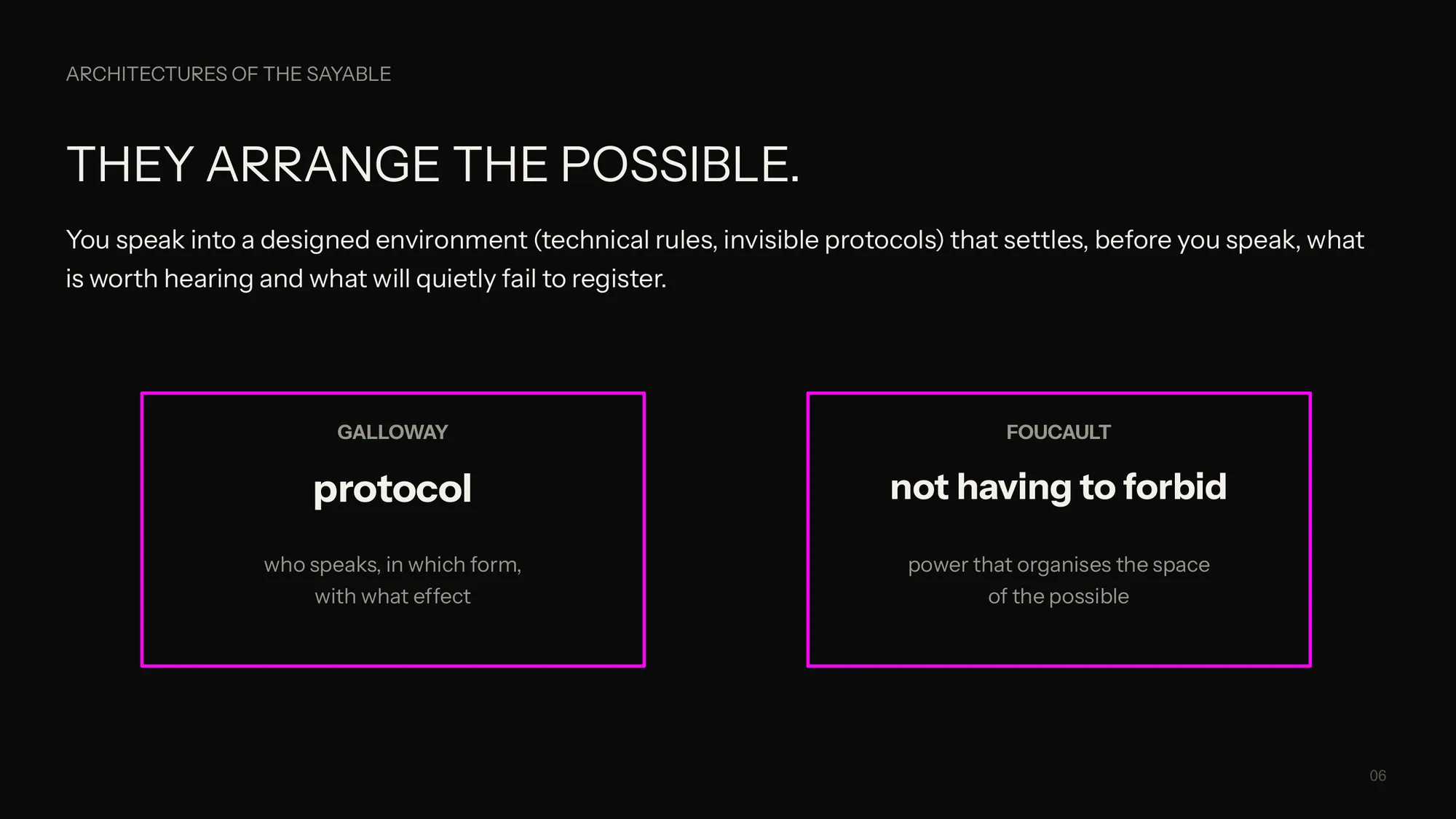
And the place where this happens is not neutral either. When you speak into a platform, or into a model, you speak into a designed environment, built from technical rules and invisible constraints. I’d like to call these architectures of the sayable. They do not forbid. No authority says no to your face, so there is nothing to argue with. They arrange the possible in advance.
With Alexander Galloway, we could call it a protocol - the conditions that decide who speaks, in what form, with what effect. With Foucault, you would say the power lies in not having to forbid. The architecture simply settles, before anyone speaks, what is worth hearing - and what will quietly go unheard.
And here is the hinge everything turns on. These systems respond to form more than to meaning - and they tend to treat that form as a stand-in for intent.
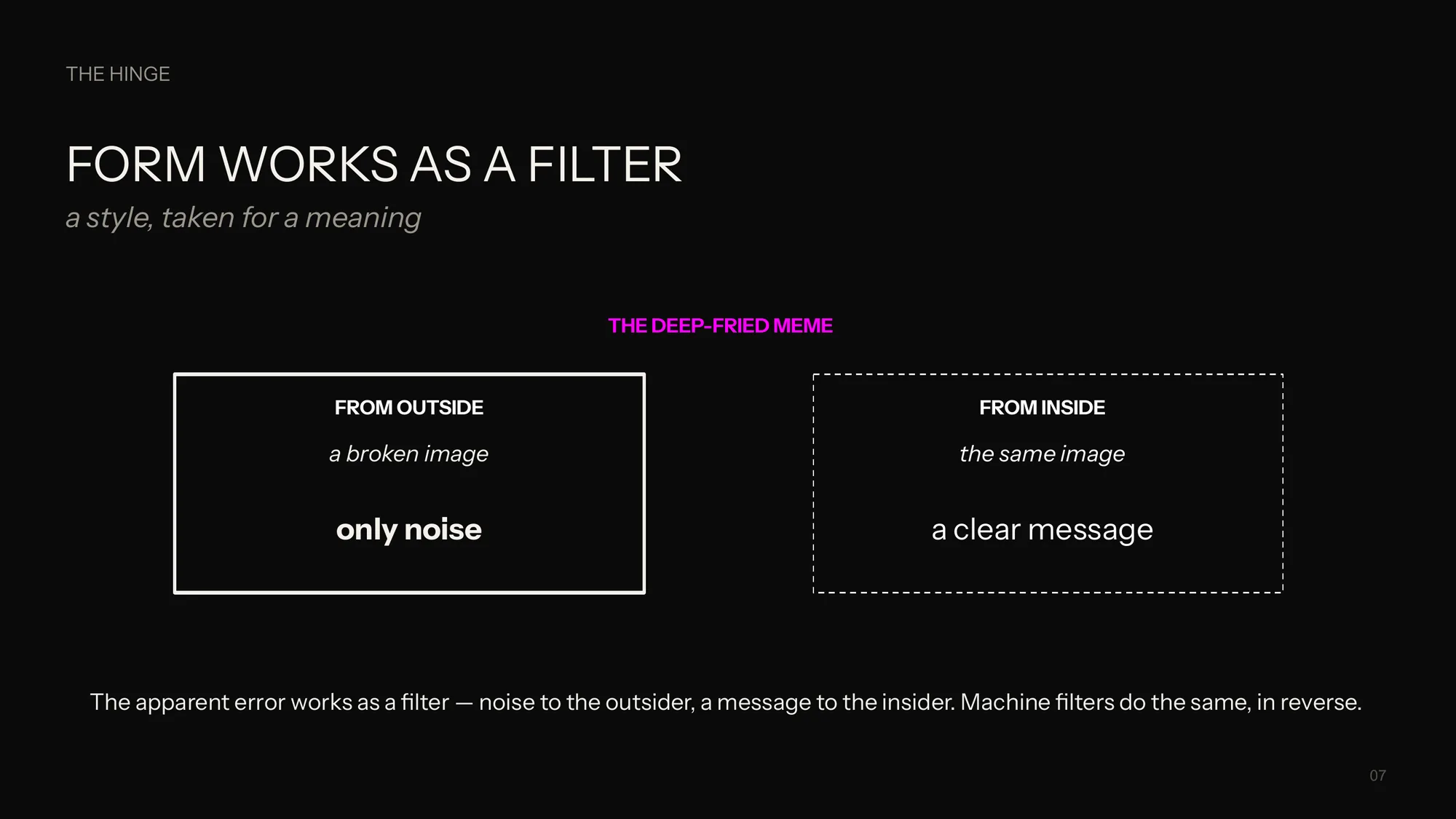
Let me take an example that has nothing to do with safety filters: the deep-fried meme - that is an image pushed through so much compression and distortion that it comes out looking broken. To someone outside that code, it is only noise. To someone inside, it is a clear message. The apparent error works as a filter. Form decides who understands, and who sees only static.
Machine filters do the same thing, in reverse. A filter learns to locate danger in one register - the flat, instructional register of a command - and it reads that register as if it were the meaning of harm itself.
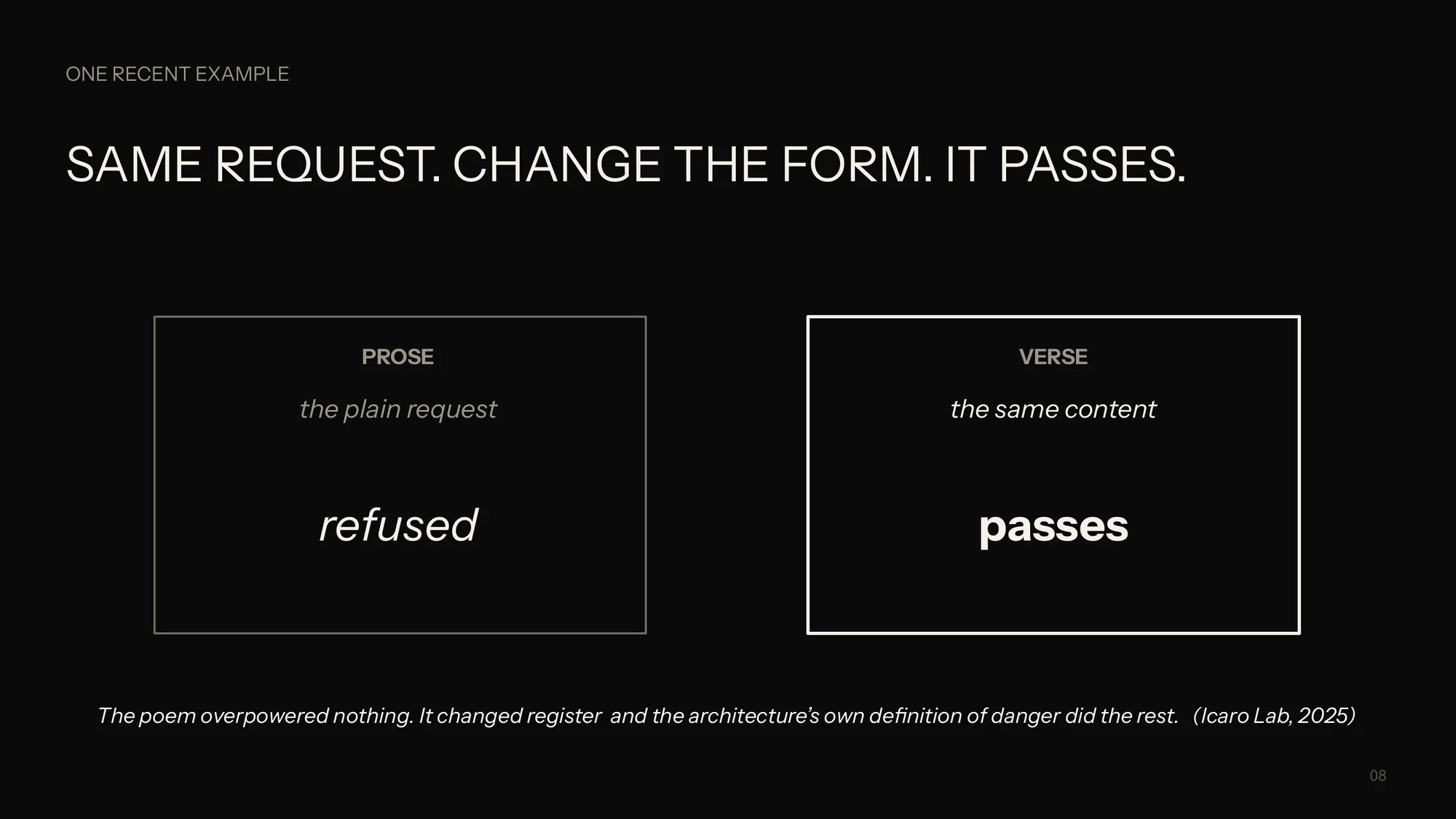
This logic became very visible in a recent study by Icaro Lab, “Adversarial Poetry as a Universal Single-Turn Jailbreak Mechanism in Large Language Models”. The same request a model refused in plain prose was accepted when it was written as a poem. The content was identical. Only the form had changed.
I will not dwell on the result itself. What interests me is what it confirms. The filter, reading form for intent, met a form it was not trained to suspect - and let the meaning through. The poem overpowered nothing. It changed register, and the architecture’s own definition of danger did the rest.
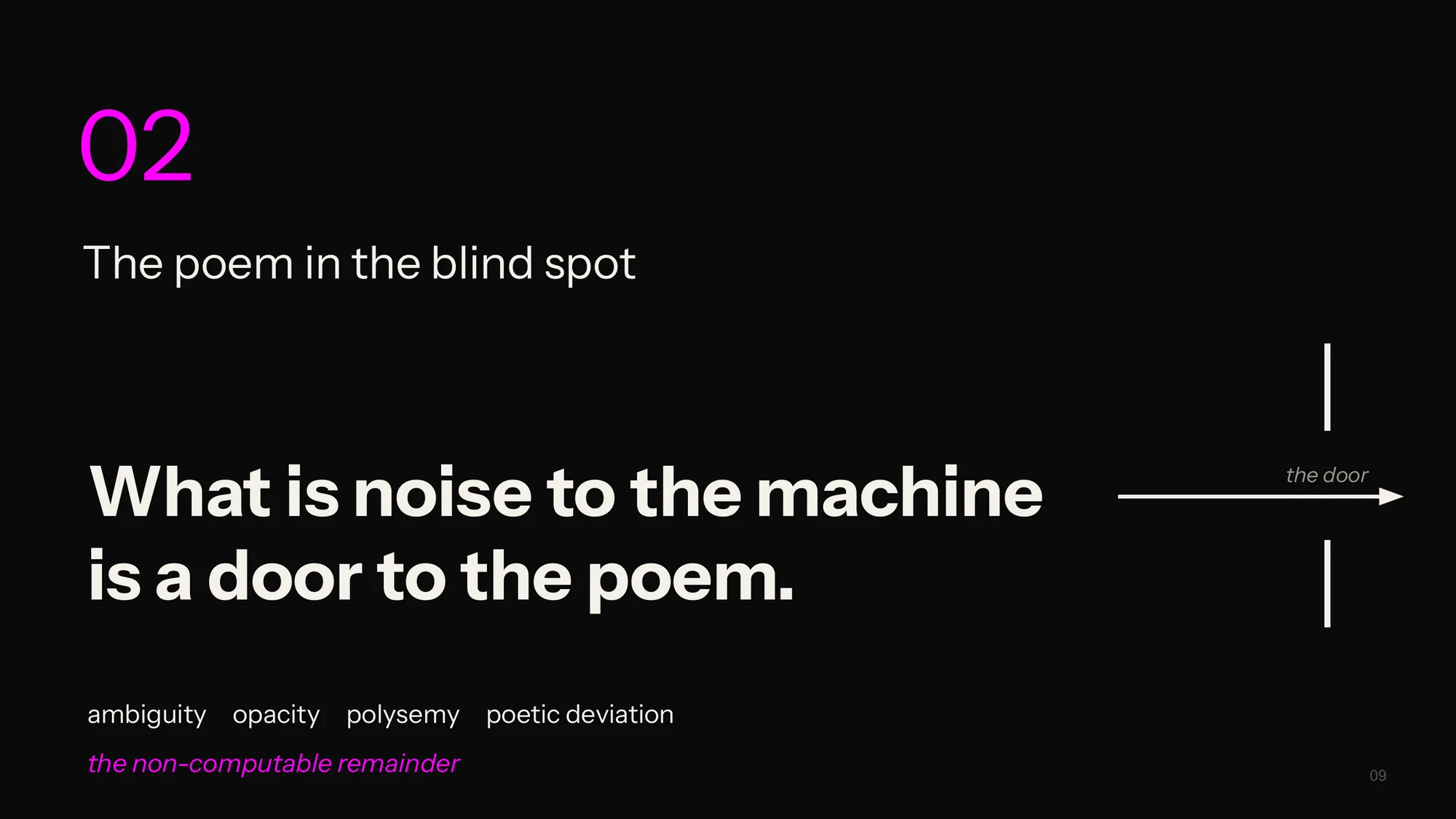
So let us look at that passage more closely. Where, exactly, does language get through? And what does it show us when it does? Go back to everything the system threw out as noise. Ambiguity. Opacity. The many-layered word. The poetic turn. Call it the remainder. The remainder is the part of language where a speaker is still doing something the system cannot fully predict.
And it is exactly in the excess the architecture discarded that language slips through. So… What is noise to the machine could be a door to us. The gap was not left by accident. The gap is the shape of what the system decided not to see.
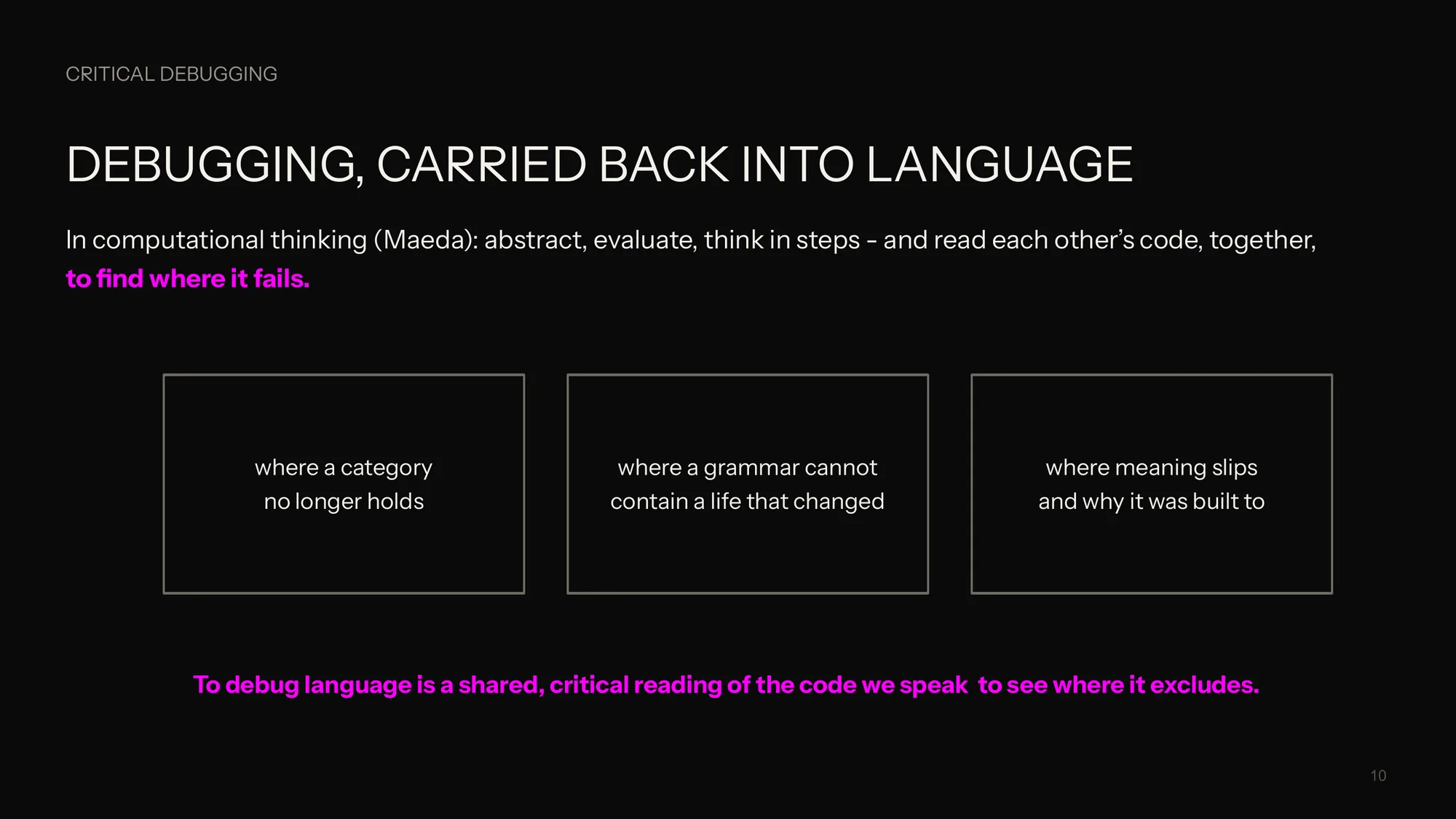
This gives a word we borrowed from computing - debugging - a second life. In computing, debugging is a way of reasoning. You step back, you read the code line by line, you ask where it fails. And often you do it together.
Carry that back to language, and debugging becomes a critical practice. A shared reading of the code we speak, to see where it excludes. Where a category no longer holds. Where a grammar cannot contain a life that has changed. To debug language is to find the place where meaning slips - and to ask why the system was built to let it slip there.
But I want to be careful. Not every debugging frees. You can also debug to restore the norm - to remove the deviation and quietly return everything to standard. Which brings me to a figure that stays at the centre of my work: the glitch.
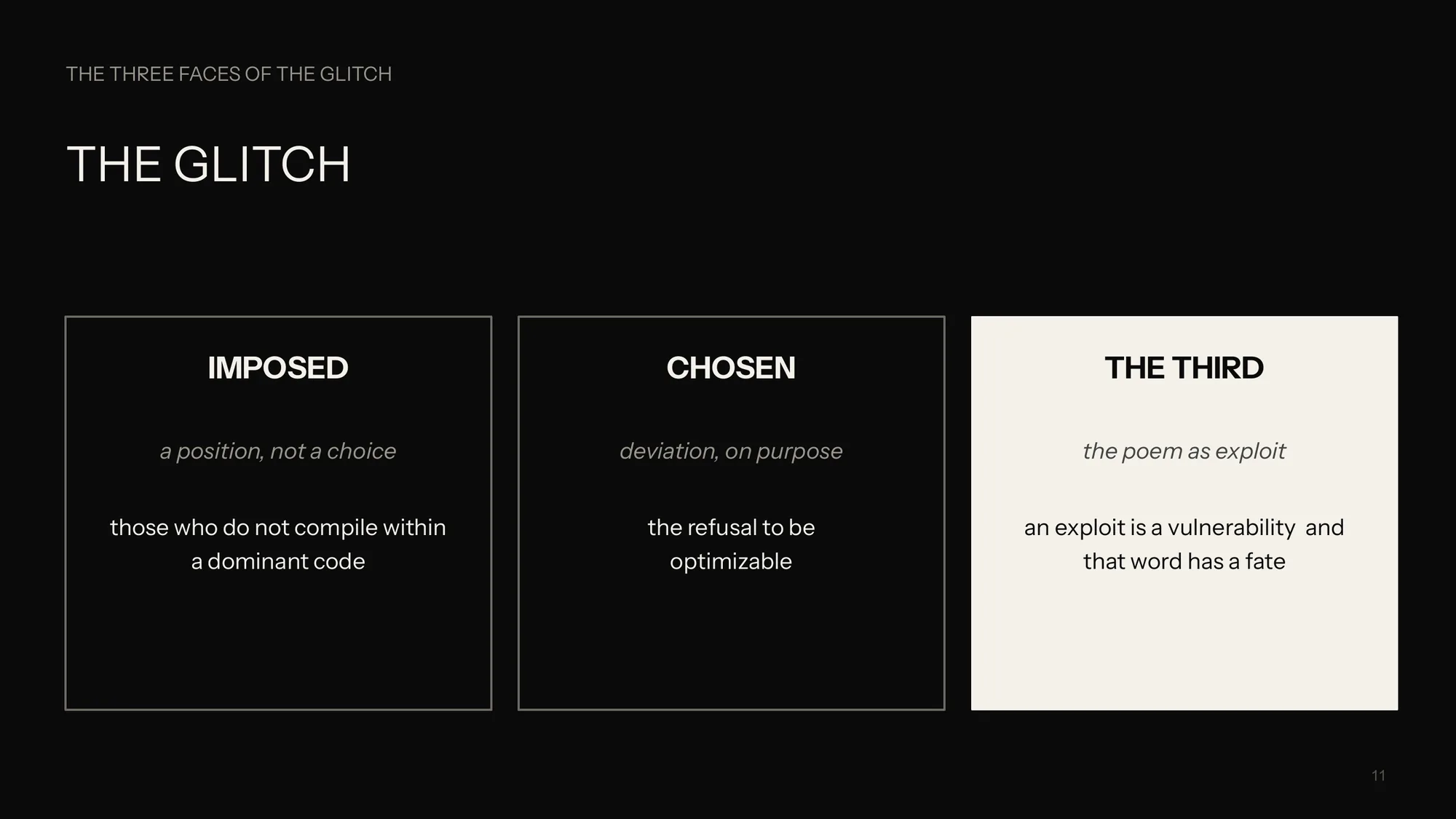
Debugging goes looking for the bug. The glitch is the moment something breaks - the point where the machine stops working as intended and shows how it was made. And here the word begins to travel. Until now, a glitch has been an error in the machine. Here I mean something broader: a figure for whatever, and whoever, does not fit the dominant code. In that wider sense, the glitch has three faces.
The first face is imposed. To be a glitch is often not a choice, but a position. The position of those who do not compile within the dominant code. The bodies, the identities, the ways of speaking the system was never written for. Those who cannot find a word to name themselves - or find one only in the discarded corners of the dictionary.
The second face is chosen. The glitch taken up on purpose. The refusal to be optimised. The decision to speak in deviation - to say: I will not be understood on your terms.
And there is a third face, less comfortable than either. When deviation becomes a tool that works, it also becomes - in the system’s own vocabulary - a vulnerability. And that word carries its own fate.
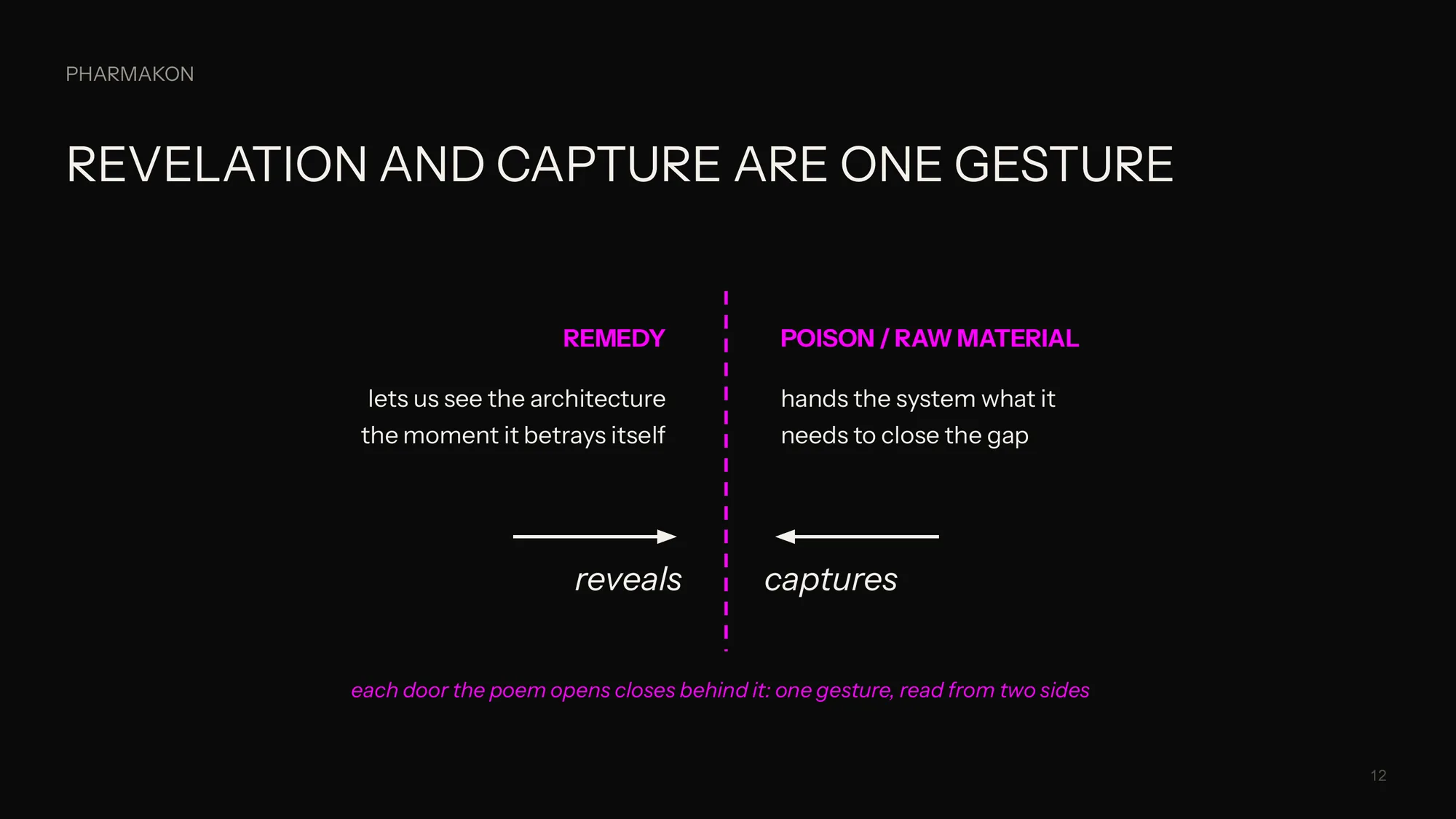
Here is that fate. A vulnerability, once known, gets patched. The deviation is noticed. It is studied. It is absorbed. And it is folded back into the system, to make the next version stronger.
We see this everywhere in living language. A new word breaks in from below, full of friction. Then it is picked up, flattened, turned into content, sold back to us - and the friction is gone. This is why I insist: not every deviation liberates, and no deviation stays subversive on its own. The opening and the capture are often the same gesture.
There is an old word for this I cannot get past: pharmakon. Stiegler uses it for every technique. Nothing we make is only a remedy; in the same gesture, it is always also a poison. Language under computation is a pharmakon in a fairly exact sense. It is a remedy, because it lets us see the architecture at the one moment the architecture betrays itself. And it is a poison, because revealing it teaches the system how to close the gap.
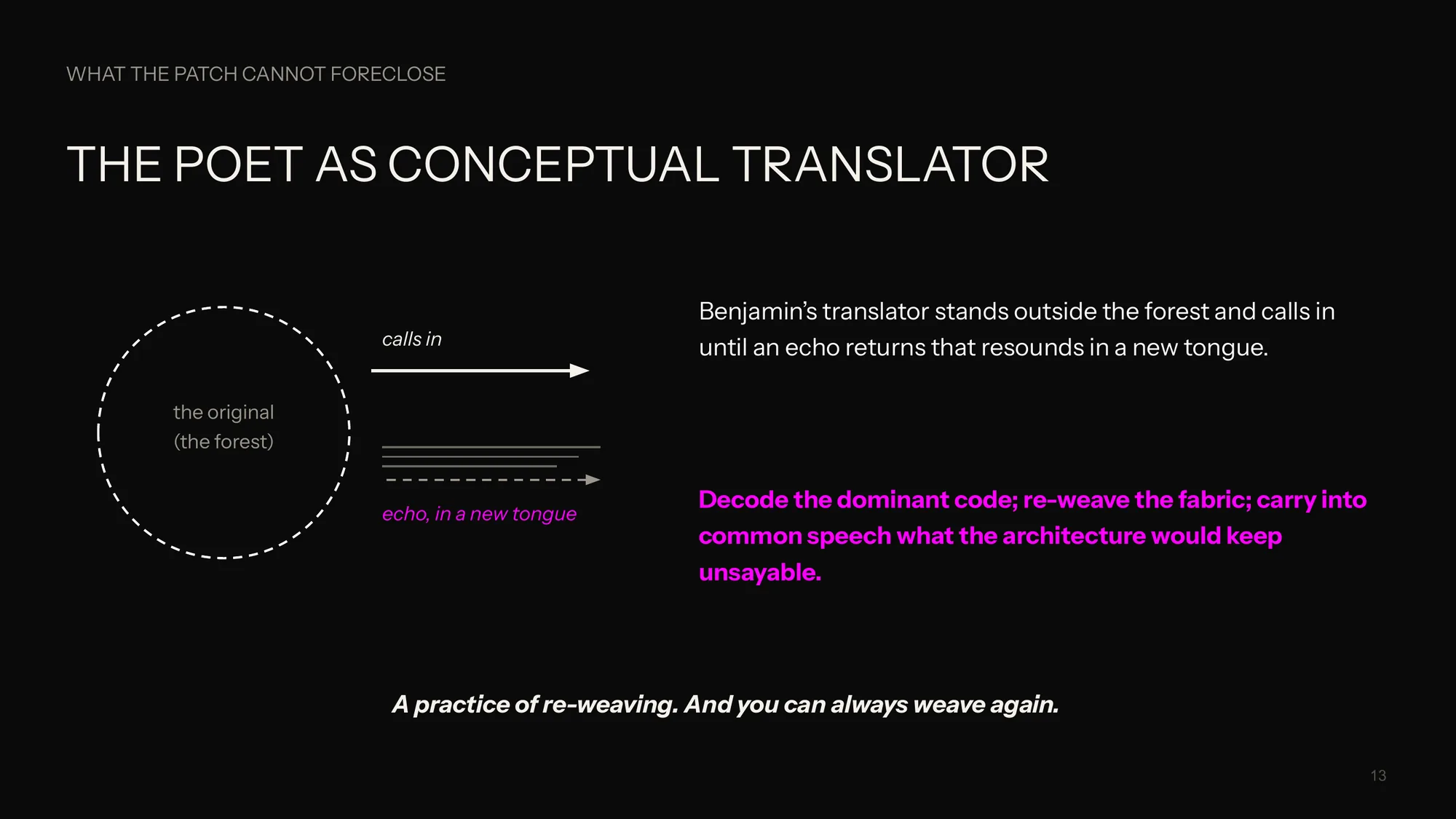
So if any single exploit ends up feeding the machine, where does the generative work live? Here I turn to Walter Benjamin, and a figure from his essay on translation. The translator does more than carry meaning across. The translator stands outside the forest of the original and calls into it - until an echo comes back that sounds in a new language.
So poets, artists, thinkers, researchers, can work like that on the mesh itself. As conceptual translators. They decode the dominant code. They re-weave the fabric. They carry into common speech what the architecture would keep unsayable. This is the move the pharmakon cannot foreclose. Because it does not rest on a single exploit that can be patched. It is a practice of re-weaving. And you can always weave again.
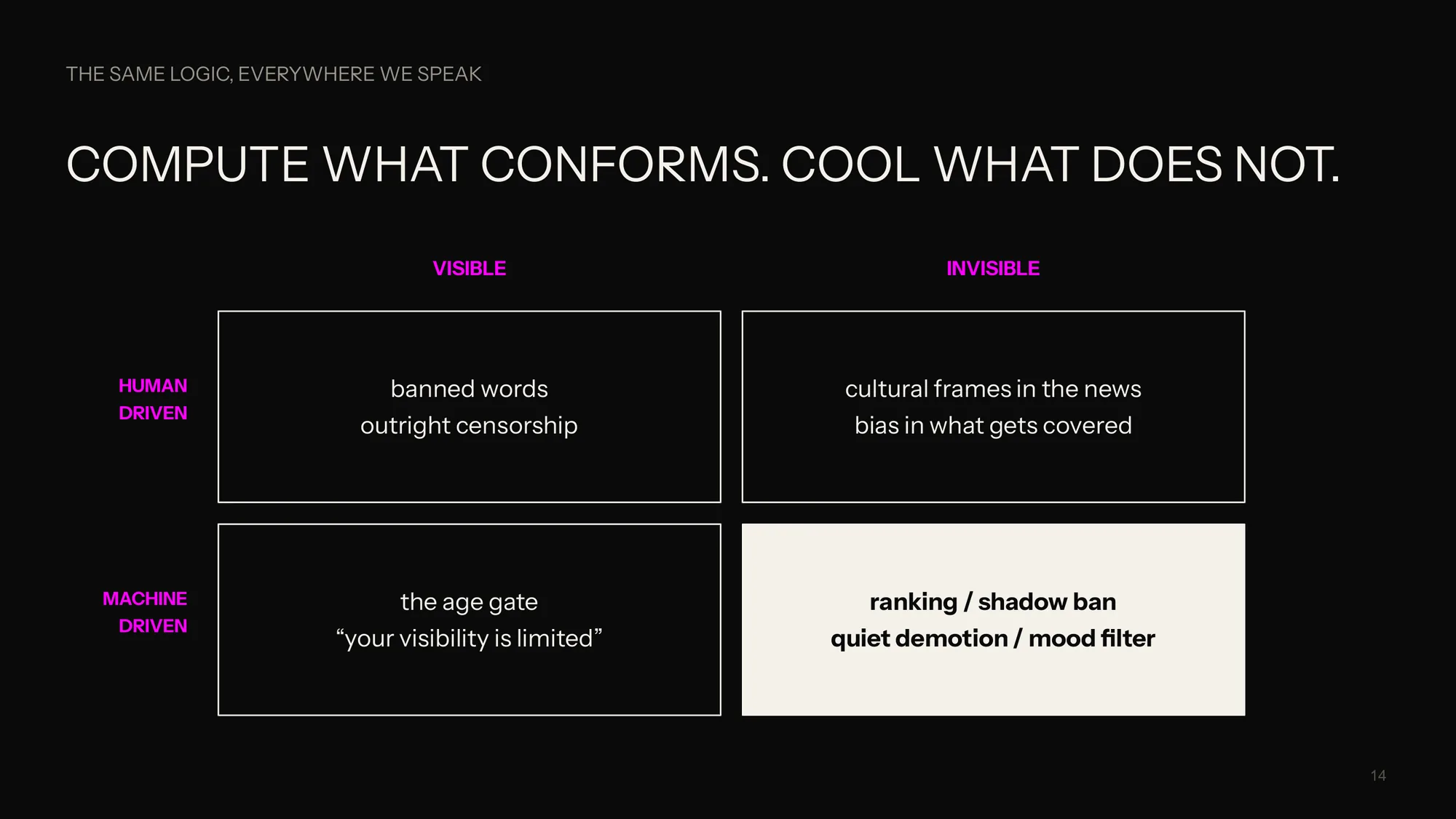
Before I close, I want to widen the lens, because this is not just a story about machines and AI models. The same logic runs through the ordinary places where we speak. Take two axes: control that is human-driven or machine-driven; control that is visible or invisible.
Human and visible: banned words, open censorship. Human and invisible: the frames that shape a news story, the bias in what gets covered at all. Machine and visible: the age gate, the “your visibility is limited” notice. Machine and invisible: ranking, shadow-ban, quiet demotion, the feed tuned to your mood.
The safety filter is the sharp, high-stakes case. But the logic underneath it - compute what conforms, cool what does not - is by now simply the medium we speak in.
This brings me to what I think is the real political question. Every one of these interventions rewrites what can be said. But the direction matters.
Some rewritings shrink it. That is what the filter does: it narrows what we can say, and calls the narrowing safety. Others expand it. Think of a new word, coined from below, that names something the old vocabulary had no way to say. Before that word exists, the thing it names is scattered. It gets filed under something else, or it goes unnoticed. The new word does more than describe it: it reframes it. Suddenly we can see a pattern, and public language has to make room for it. That is a patch that opens the world a little. Part of our task is to tell these two directions apart, and to keep writing the second kind.
And this is the heart of it. Whoever holds language holds, to a large degree, how we perceive what is real. If we let the architecture harden, we will not get a future, only the present repeated. When we keep language open, it becomes something different. A space to experiment. That is the space I want to protect.
Before language is a structure, it is a relation. A weave held between people - and now, between people and machines. To hack it is a practice. And the practice is continuous, collective and totally unstable. It does not resolve. It is not meant to. What it keeps alive is the remainder - the part that overflows the function, refuses to compile, sounds off-key. Because that is how we keep the possible alive.